Cart
0
You may also like


You may also like
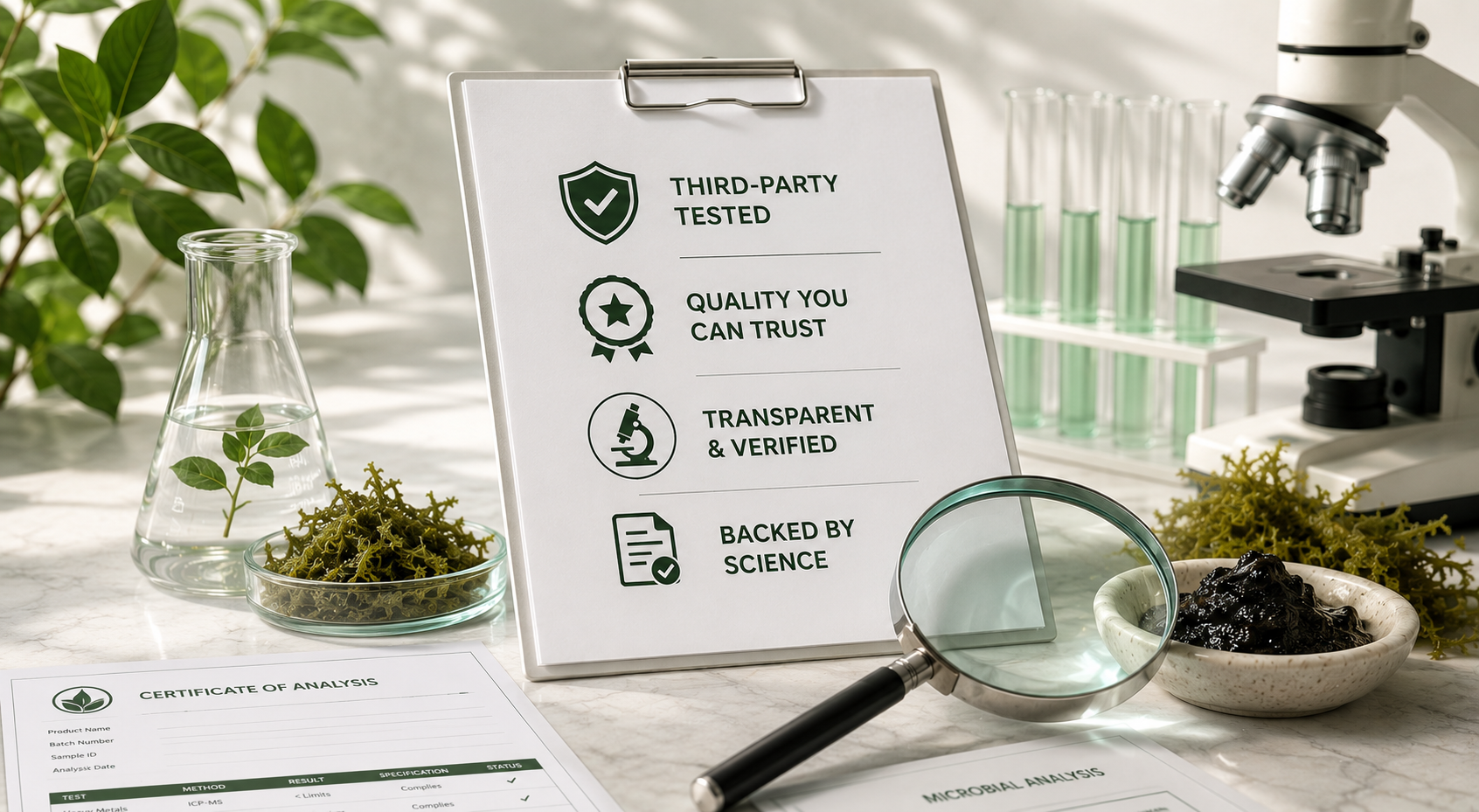

Table of Contents
Supplement options keep multiplying, and a well-designed label only tells a practitioner so much. What actually separates a well-made product from a well-marketed one usually comes down to something most consumers never see: independent verification. This article looks at how third-party testing gives healthcare professionals something more solid to stand on than promotional copy, and why that distinction matters when a recommendation carries someone's name behind it.
Third-party testing means sending a finished supplement to a laboratory that has no financial relationship with the manufacturer. Because that lab has nothing to gain from a favorable result, its findings offer a more objective read on whether a product actually matches its specifications.
Depending on the formulation, an independent laboratory might look at ingredient identity, purity, heavy metal levels, microbiological safety, environmental contaminants, batch consistency, and whether the finished product matches what's printed on the label. None of this is meant to support therapeutic claims. It exists to confirm that a product was made the way it says it was made, which is a narrower and more useful question for a practitioner to have answered.
Patients ask questions, and practitioners need answers grounded in more than a product description. Packaging can describe ingredients and manufacturing practices, but it's written by the company selling the product. Independent verification sits outside that relationship.
In practice, this kind of testing gives practitioners a few concrete things to work with:
Laboratory data that wasn't generated or reviewed by the manufacturer itself
A clearer picture of ingredient transparency and manufacturing consistency
A way to compare brands on something more objective than marketing language
Documentation that supports confidence in a recommendation, rather than just a hope that it's accurate
None of this replaces a broader evaluation. Laboratory verification works best as one part of a larger assessment that also includes sourcing practices, manufacturing standards, and how transparent a brand is willing to be about all of it.
Third-party labs run different evaluations depending on the product and its ingredients, but a few categories come up consistently.
Identity testing confirms that what's actually in the finished product matches what the label claims. For marine-derived supplements, that often means verifying specific botanicals such as Chondrus crispus, red algae, brown algae, or gold algae. This step matters more than it might sound like it should, since it's the difference between a company saying it used a particular marine ingredient and a lab confirming that it did.
Purity testing checks whether a finished product meets its quality specifications, typically screening for heavy metals, microbial contamination, environmental contaminants, foreign materials, and manufacturing impurities. Together, these checks form the backbone of quality assurance, confirming that a product went through real laboratory evaluation before it reached a shelf.
Natural ingredients shift from one harvest to the next, sometimes more than people expect. Batch testing exists to track that variation and make sure it doesn't translate into inconsistent products, covering things like ingredient verification, documentation, and traceability from one production run to the next. For a practitioner, this is what makes it possible to trust that a product recommended in January performs the same way in July.
Marketing copy tends to talk in broad strokes about wellness benefits. Practitioners are usually better served by something narrower: objective indicators they can actually check. A transparent brand will typically share information about ingredient sourcing, manufacturing standards, third-party laboratory verification, batch testing, and its own quality assurance process, rather than leaning entirely on promotional language.
That's the difference between an evidence-informed approach to supplement selection and one built on advertising. It's not that marketing claims are automatically wrong. It's that they aren't independently checked, and documentation is.
Marine-derived ingredients bring their own complications. Because environmental conditions can shift a plant's natural composition from one harvest to the next, responsible manufacturers tend to lean more heavily on laboratory verification than they might with a more stable, synthetic ingredient.
Marine Botanical Science is the study of the marine plants and algae used in these formulations, ingredients that naturally contain compounds like marine polysaccharides, fucoidan, alginates, and trace minerals. Marine Mineral Formulations bring these ingredients together while keeping their sourcing and verification process visible rather than buried. Independent laboratory testing supports that by confirming ingredient identity and manufacturing consistency, without inflating what the product is claimed to do.
It's tempting to assume that once a formulation is set, every batch produced afterward comes out identical. In practice, that assumption doesn't hold, especially for ingredients pulled from the ocean rather than synthesized in a lab. Batch-Tested Marine Nutrition treats each production run as its own thing to verify: checking ingredient consistency, tracking naturally occurring variation, maintaining production standards, and documenting the laboratory findings behind all of it.
This matters more for marine ingredients specifically, since mineral profiles can shift depending on where and when something was harvested. A batch pulled from cooler waters in one season isn't guaranteed to look exactly like one pulled six months later.
Some marine ingredients naturally contain iodine, and the amount can vary from harvest to harvest. Rather than relying on an estimated average, responsible manufacturers measure iodine content for individual batches. Batch-Specific Iodine Verification supports formulation consistency, gives practitioners documented laboratory findings instead of assumptions, and helps confirm that a product's quality specifications actually hold up batch by batch, not just on paper.
A short list of practical questions can go a long way when evaluating a new supplement brand.
On laboratory testing: Is the supplement independently tested? Is Third-Party Laboratory Verification actually available to review? Can you access recent laboratory reports, or only a summary claim?
On manufacturing: Is every production batch tested, or only occasional samples? Are manufacturing standards documented somewhere a practitioner can actually see them?
On ingredients: Are botanical or marine ingredients clearly identified rather than hidden behind vague blend names? Is sourcing explained in any real detail?
On transparency generally: Does the company explain its quality assurance process without being asked, or only when pressed? Is testing performed by a lab with no financial stake in the outcome?
These questions push the conversation toward documentation instead of marketing, which is usually where it should have started.
Healthcare professionals tend to look past the label toward how a supplement was actually sourced, tested, and manufactured. iDUNNlife builds its process around that expectation, emphasizing Third-Party Laboratory Verification across its marine wellness products so that ingredient identity, purity, and manufacturing consistency can be checked rather than taken on faith.
The brand's formulations are built around carefully selected marine botanicals, including Chondrus crispus along with brown algae and gold algae where applicable, developed under the principles of Marine Botanical Science and Marine Mineral Formulations. That includes naturally occurring compounds such as fucoidan, alginates, marine polysaccharides, and trace minerals.
Beyond ingredient selection, that same standard extends to Batch-Tested Marine Nutrition, Batch-Specific Iodine Verification for applicable formulations, sustainably sourced marine ingredients, small-batch production, and manufacturing that stays vegan-friendly, gluten-free, and non-GMO throughout.
1. What is third-party testing for supplements?
2. Why is third-party laboratory verification important when selecting supplements?
3. What should healthcare professionals look for in a third-party tested supplement?
4. How often should supplements be batch tested?
5. Does third-party testing guarantee a supplement's effectiveness?